



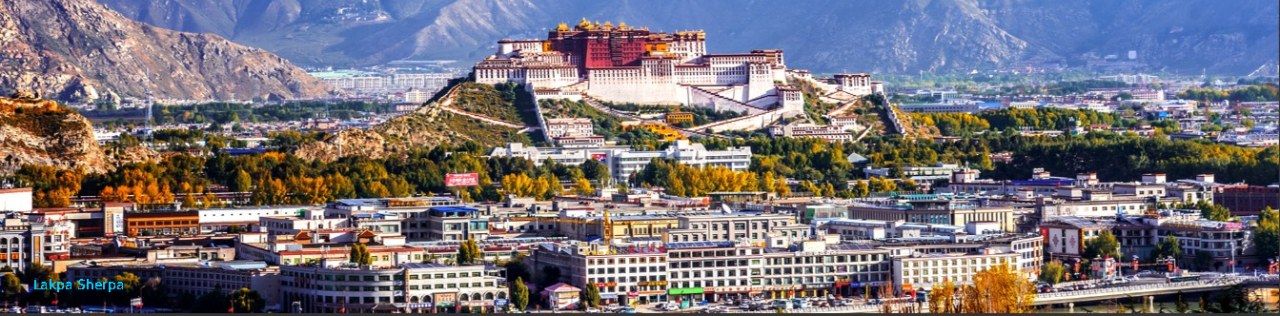
Tibet Travel Guide – Complete Travel Information by
Unique Sherpa Trek & Expedition Pvt. Ltd.
Tibet, often called the Roof of the World, is one of Asia's most fascinating travel destinations. Known for its breathtaking Himalayan landscapes, ancient Buddhist monasteries, sacred lakes, high mountain passes, and deep spiritual traditions, Tibet offers an unforgettable adventure for travelers seeking culture, history, nature, and high-altitude exploration. From the magnificent Potala Palace in Lhasa to the legendary Mount Kailash pilgrimage and the northern view of Mount Everest, Tibet remains one of the world's most extraordinary destinations. Spring (April–June) and autumn (September–October) are generally regarded as the best seasons for clear mountain views and comfortable travel conditions. Visitors should also plan because foreign travelers typically require a Tibet Travel Permit in addition to any necessary visas.
1. Location
Tibet is a vast high-altitude region located in the heart of Asia on the Qinghai–Tibet Plateau, the world's highest and largest plateau. It is bordered by Nepal, India, Bhutan, and Myanmar to the south, while China's provinces of Qinghai, Sichuan, Yunnan, and Xinjiang surround it on the north and east. Covering approximately 1.2 million square kilometers, Tibet is often called the "Roof of the World" because its average elevation exceeds 4,500 meters (14,760 feet) above sea level. The region is home to many of the world's tallest mountains, including the northern face of Mount Everest, and serves as the source of several major Asian rivers such as the Brahmaputra (Yarlung Tsangpo), Indus, Mekong, Salween, and Yangtze. Its strategic location between the Himalayas and the Tibetan Plateau has made Tibet an important cultural, religious, and trade crossroads for centuries.
2. Geography
Tibet features one of the planet's most dramatic landscapes, with snow-covered Himalayan peaks, vast alpine meadows, glaciers, turquoise lakes, deep river valleys, and high-altitude deserts. The southern border is dominated by the Himalayas, while the central region consists of broad plateaus and fertile valleys where most settlements are located. Western Tibet is famous for the sacred Mount Kailash and Lake Manasarovar, while eastern Tibet offers dense forests, deep gorges, and rich biodiversity. The region includes some of the world's highest mountain passes, spectacular lakes such as Yamdrok and Namtso, and countless glaciers that feed Asia's major river systems.
3. History
Tibet has a rich history spanning more than 1,300 years. During the 7th century, King Songtsen Gampo united various Tibetan kingdoms and established the Tibetan Empire, introducing Buddhism and promoting cultural development. In later centuries, Tibetan Buddhism became the dominant religious and cultural force, leading to the construction of famous monasteries and palaces throughout the region. The Dalai Lama institution emerged as a central religious leadership tradition, and Lhasa became the spiritual center of Tibetan Buddhism. Today, Tibet preserves its unique cultural heritage through its monasteries, traditions, festivals, language, and religious practices, making it one of Asia's most distinctive cultural destinations.
4. Climate
Despite its high altitude, Tibet experiences abundant sunshine throughout the year, earning the nickname "Land of Sunshine." The climate varies significantly depending on elevation and region. Summers (June to August) are generally mild, with daytime temperatures ranging from 15°C to 25°C, while winters can be very cold, especially in northern and western Tibet, where temperatures may fall well below freezing. Spring and autumn are considered the best seasons for travel due to stable weather, clear mountain views, and comfortable trekking conditions. Rainfall is relatively low compared to neighboring Himalayan regions, although the summer monsoon brings occasional showers to southeastern Tibet.
5. Population
Tibet has a population of approximately 3.6 million people, with the majority living in the valleys and urban centers such as Lhasa, Shigatse, and Nyingchi. Ethnic Tibetans make up the largest share of the population, alongside Han Chinese, Hui, Monpa, Lhoba, and several smaller ethnic communities. Many Tibetans continue traditional lifestyles centered around agriculture, yak herding, handicrafts, and religious activities, while modern cities are experiencing increasing development in education, healthcare, tourism, and transportation.
6. Religion
Religion forms the heart of Tibetan identity. Tibetan Buddhism is the dominant faith, influencing nearly every aspect of daily life, architecture, festivals, art, and local customs. The region is home to thousands of monasteries, temples, prayer wheels, stupas, and sacred pilgrimage routes. Important religious sites include the Potala Palace, Jokhang Temple, Sera Monastery, Drepung Monastery, Tashilhunpo Monastery, Mount Kailash, and Lake Manasarovar. Pilgrimage remains an essential tradition, with devotees traveling long distances to complete sacred circuits known as "Kora."
7. Languages
The primary language spoken throughout Tibet is Tibetan, which has several regional dialects. Standard Tibetan is widely used in education, religious ceremonies, literature, and local communication. Mandarin Chinese is also commonly spoken in cities, government offices, transportation services, and tourism businesses. English is becoming increasingly available in hotels, travel agencies, and among professional tour guides, although it is less common in rural areas.
8. Currency
The official currency used in Tibet is the Chinese Yuan Renminbi (CNY), commonly referred to as RMB. Banknotes are available in denominations ranging from 1 to 100 Yuan. Cash is widely accepted across Tibet, while mobile payment systems and bank cards are increasingly available in larger cities such as Lhasa and Shigatse. Visitors traveling to remote areas should carry sufficient cash, as banking facilities and card payment options may be limited outside major towns.
9. Time Zone
Tibet follows China Standard Time (CST), which is UTC +8 throughout the year. There is no daylight saving time. Although sunrise and sunset may occur later than expected because of Tibet's western location within the time zone, daily activities, transportation schedules, and business hours all follow China Standard Time.
10. Government
Tibet functions as the Tibet Autonomous Region (TAR) within the People's Republic of China. The regional government administers public services, infrastructure, education, healthcare, transportation, environmental conservation, and tourism development in accordance with China's national legal framework. Travelers should be aware that foreign visitors must obtain the necessary travel permits before entering the Tibet Autonomous Region.
11. Economy
Tibet's economy is supported by tourism, agriculture, animal husbandry, traditional handicrafts, renewable energy, and infrastructure development. Yak and sheep farming remain essential to rural livelihoods, while barley cultivation produces the staple grain used to make Tsampa, Tibet's traditional food. Tourism has become one of the region's fastest-growing industries, attracting visitors interested in Himalayan scenery, Buddhist culture, pilgrimage routes, trekking, photography, and overland adventures. Major infrastructure improvements, including highways, airports, and the Qinghai–Tibet Railway, have enhanced accessibility while supporting regional economic growth.
12. Culture
Tibetan culture is one of the oldest and most distinctive cultures in Asia. It is deeply rooted in Buddhist philosophy and reflected in colorful festivals, traditional music, dance, religious ceremonies, art, architecture, and everyday life. Prayer flags flutter across mountain passes, monasteries preserve centuries-old manuscripts and murals, and artisans continue producing intricate thangka paintings, carpets, jewelry, and wood carvings. Traditional clothing, yak butter tea, Tibetan hospitality, and vibrant cultural festivals such as Losar, Saga Dawa, and the Shoton Festival offer visitors a unique insight into the living heritage of the Tibetan people.
13. Tourism
Tibet is one of the world's most extraordinary travel destinations, offering unforgettable experiences for adventurers, photographers, pilgrims, and cultural travelers alike. Highlights include exploring the historic streets of Lhasa, visiting the iconic Potala Palace and Jokhang Temple, traveling overland from Kathmandu to Lhasa, witnessing the breathtaking northern face of Mount Everest, completing the sacred Mount Kailash Kora, and discovering pristine lakes such as Yamdrok and Namtso. Visitors can also enjoy monastery tours, high-altitude trekking, wildlife observation, cultural festivals, and scenic road journeys across the Tibetan Plateau. With professional planning, experienced local guides, and carefully designed itineraries, Unique Sherpa Trek & Expedition Pvt. Ltd. provides safe, authentic, and memorable Tibet journeys that combine spectacular Himalayan landscapes with the rich spiritual heritage of the region.